
Minnesota Paid Leave
Publish Date
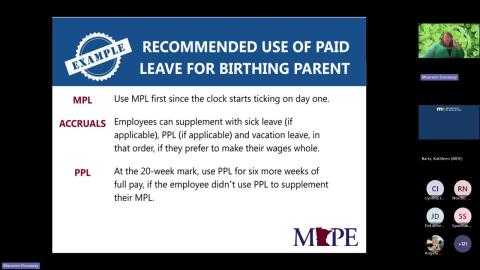
Leave comparison

Leave example
Minnesota Paid Leave (MPL) FAQ
What is Minnesota Paid Leave (MPL)?
-
MPL is a new program beginning January 1, 2026, which provides a partial wage replacement and job protection for qualifying medical and family leave events.
Who qualifies for MPL?
-
If you work at least 50% of your time in the State of Minnesota and earned at least $3,900 in qualifying income in Minnesota in the last year (approximately), you qualify for MPL.
-
The last year is based on income reported for completed calendar quarters.
-
An employee may be eligible even if they are probationary, temporary, or part-time.
How is MPL funded?
-
Each employer pays a 0.88% premium on all W-2 wages paid to employees. Minnesota Management and Budget (MMB), like most other employers, is passing 50% of the premiums onto employees, which they are entitled to do under the law. That means that employees are paying 0.44% of their pre-tax wages per pay period as a premium for MPL.
What does MPL cover?
-
Up to 12 weeks of medical leave per year to care for your own serious health condition. This can include pregnancy or childbirth, surgery, chronic condition, injury, or other health needs your provider certifies.
-
Up to 12 weeks of family leave per year, which can be used for the following reasons:
-
To bond with a child through birth, adoption, or foster placement.
-
To care for a family member with a serious health condition.
-
To support a military family member called to active duty.
-
To respond to certain personal safety issues such as domestic violence, sexual assault, or stalking, for you or a family member.
-
However, an individual employee may only take a total of 20 weeks of MPL leave in a year. For example, if you take twelve weeks of medical leave, you can only take eight weeks of family leave.
-
MPL uses a “rolling year”, meaning that the year begins on the first day you take MPL.
What is a qualifying event under MPL?
-
MPL can be used for your own serious health condition or a family issue which requires you to be away from work for at least seven days. The seven days do not have to be in a row.
What benefits do I receive from MPL?
-
The benefits are calculated as a percentage of your average weekly wage as follows:
-
For weekly wages between $0 and $711.50 (half of the current state average), you get paid 90%.
-
For weekly wages between $711.50 and $1,423 (the current state average), you get paid 66%.
-
For weekly wages above $1,423, you get paid 55%.
-
The maximum benefit you can receive for 2026 is $1,423 per week.
-
Check out this calculator at the MPL site for more information.
If I have a qualifying event, how do I apply for MPL?
-
If foreseeable, notify Human Resources (HR) at least 30 days in advance of your intent to take leave. Each agency will be responsible for its own notification policies and procedures, so connect with HR to ensure you know the notification requirements.
-
HR will require proper documentation for MPL leave.
-
Sufficient documentation includes: a Family Medical Leave Act (FMLA) medical certification form, MPL medical certification form, or other written notice allowed by the MPL law.
-
Create an account and apply through DEED at this link.
How soon are MPL benefits paid after I apply? Is there a waiting period?
-
The MPL program estimates that it will issue determinations of eligibility within two weeks of an application being filed. The MPL program is designed to pay benefits for each week of approved leave. There is not a waiting period.
-
In some cases (for example, if the employee is injured and does not know how long they will be unable to work), employees must wait until at least seven calendar days of leave have occurred before applying for partial wage benefits. If approved, they will be retroactively paid partial wage benefits for that period of time.
How does MPL interact with other leaves?
-
MPL runs concurrently (that is, on the same clock) with most other leaves, including FMLA and medical leave.
-
If you take Paid Parental Leave (PPL) during your twenty weeks of MPL, it will run concurrently. However, if you have PPL remaining after your twenty weeks of MPL, you may use that time at the end to extend your total leave. You must still use PPL within six months of the birth or adoption or the child, unless the Appointing Authority agrees to allow intermittent use.
Can I use other paid leaves to supplement or “top off” MPL payments?
-
MMB is allowing employees to supplement or “top off” their MPL payments with paid leave upon request of the employee.
-
Employees who choose to supplement with paid leave must elect in writing whether and how much they will supplement for the duration of the leave period.
-
If an employee chooses to supplement with paid leave, MMB has determined the employee must first use accrued sick leave (if applicable), then PPL (if applicable), and lastly, accrued vacation leave.
-
Accrued sick leave may only be used for events that qualify for sick leave: for example, sick leave may not be used for bonding time with a new child but may be used for recovery from childbirth.
-
PPL may only be used for events that qualify for PPL.
If I use paid leave to supplement my MPL, how much can I use?
-
An employee cannot receive more than their regular wage or salary in combined MPL benefits, supplementing with paid leave, or payment for hours worked.
-
Exception: Short-Term Disability (STD) is an insurance benefit, not a paid leave, and is unaffected by MPL, meaning that STD doesn’t count towards your replacement wage. Unlike STD, Long-Term Disability amounts are reduced by MPL benefits.
What happens if I supplement with paid leave and am overpaid?
-
If an employee receives more than their regular wage or salary, due to the combination of MPL benefits, supplementing with paid leave, or payment for hours worked, the employee is responsible for repayment of any overpayment to the agency.
-
The first week of MPL is always paid retroactively, so if you supplement your full regular wage or salary that first week, you will have to pay back the amount you receive from MPL for that first week.
-
Overpayments can happen very easily the way the MPL program is designed. Be sure to work with HR to minimize that risk.
Can I take MPL intermittently?
-
All types of MPL-protected leave may be taken continuously, intermittently, or on a reduced-schedule basis. For leave based on the serious health condition of an employee or a qualifying family member, a health care provider will be asked to certify that intermittent leave is medically beneficial to the patient given their medical condition.
-
MMB policy, in accordance with statute, limits intermittent leave to 480 hours of MPL per year.
How are my job and benefits protected during MPL?
-
On return from MPL-protected leave, an employee is entitled to be returned to the same position they held when leave began or to an equivalent position with equivalent benefits, pay, and other terms and conditions of employment.
-
Some exceptions apply for those who have been employed for less than 90 days. If you are in that situation, check with HR prior to taking leave to discuss impact.
-
Employers cannot discharge, discipline, penalize, interfere with, threaten, restrain, coerce, or otherwise retaliate or discriminate against an employee for requesting or obtaining benefits or leave, or for exercising any other right under the MPL law.
-
During any leave to which an employee is entitled under the MPL law, the agency must maintain coverage under any group insurance policy, group subscriber contract, or health care plan for the employee and any dependents as if the employee were not on leave.
-
For coverage to continue, the employee must continue to pay the employee’s portion of required premiums. Since your MPL benefits are paid directly to you, that means you may want to supplement with other paid leaves to pay for your share of premiums. Employees who do not supplement, or who supplement but do not earn enough to cover the deduction, will be billed directly by SEGIP.
-
Pension contributions are not deducted from MPL wage replacement. Employees should contact MSRS for questions about their pension during MPL.
Under the current FMLA policy, employees are required to take sick leave. Will the policy address this?
-
Yes, the FMLA policy was updated to no longer require employees to exhaust their sick leave since FMLA is running concurrently with MPL and employees cannot be required to supplement their MPL with paid leave.
Will I accrue sick and vacation leave while using MPL?
-
Employees will accrue sick and vacation leave when they are in paid status and in accordance with collective bargaining agreements (CBA) and compensation plans. When employees are receiving only MPL wage replacement benefits, they are in unpaid status for purposes of leave accruals (see the CBA for details on what time counts towards accruals).
How is holiday pay going to work when I am out on MPL?
-
This will vary greatly depending on someone’s individual circumstances. As a general rule, you must use a full day of accrued paid leave (sick, PPL, or vacation) for the full scheduled workday before and after the holiday in order to receive pay for that holiday. (Since your MPL will always be greater than 50% of your pay, this is not normally a good exchange.)
Where should I go for any additional questions?
-
Contact HR first regarding any questions about MPL.
-
Contact your MAPE Steward for questions unanswered by HR.
Can I apply for MPL retroactively?
Minnesota Paid Leave does allow individuals to apply for benefits after their leave has already begun. An application must be submitted within 30 days from the start of the leave. If someone is unable to apply within that timeframe, they may still be eligible to file later if they can show good cause for the delay. Examples of good cause include medical emergencies, difficulty obtaining required documentation, safety concerns, or other circumstances outside the individual’s control.
After submitting an application, the applicant has 30 days to provide any required documentation, such as medical certification. Extensions may also be granted for good cause.
Minnesota Paid Leave (MPL) launched Jan. 1, 2026
Passed in 2023, the Minnesota Paid Family and Medical Leave Act allows workers to take up to 20 weeks of leave in a year with partial wage replacement. Employees will be eligible to use up to 12 weeks for a single qualifying event under family or medical leave and allowed to use up to eight additional weeks for the other type of leave in a year. Unlike the State's Paid Parental Leave policy, employees are not required to spend their sick leave accruals down to zero before accessing the benefit. Some employers will also allow employees to use their sick leave accruals to "top-off" the wage replacement amount to meet their salary level. The structure of the program is similar to Minnesota's Unemployment Insurance program, but the insurance premium is equally split between the employer and employee unless negotiated otherwise.
MAPE has been involved in the Minnesotans for Paid Leave campaign for nearly a decade before it was finally enacted into law. Since then, MAPE has worked with other labor unions and community organizations to combat efforts to water down or roll back benefits.
This is a state program that covers almost everyone in Minnesota who receives W2 wages, and all W2 wages are impacted - including lost time and stipends paid by MAPE. MPL is not a state worker program, new contract language or an employer benefit. We do not have the ability to opt out of the program. Agencies have sent out disclosures required by statute.
MMB just released the new paid leave policy, and we are seeking clarification on some items. More information is coming soon and will be further updated as we know more. This is going to be new for all agencies, and we anticipate they are going to have a learning curve along with everyone else in administering their part of the claims, especially since there is still ambiguity. We also know thousands of claims have already been submitted in anticipation of the Jan. 1 start date. If you anticipate using the program right away, such as childbirth or elective surgeries, please notify your HR office as soon as possible to determine the best way to proceed with required notifications. Start filling out any required forms and documentation now to ensure that your claim is processed in a timely manner.
The MPL Website has an excellent toolkit with more information.