
MAPE Sends Largest Delegation Ever to Labor Notes Conference
Valuable Insights and Experiences Gained
Publish Date
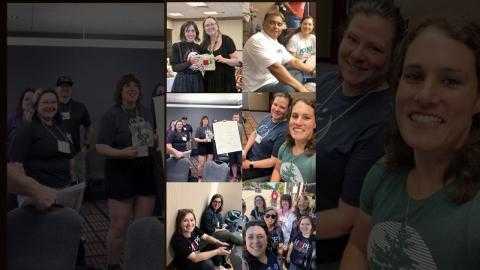

By plane, train and automobile (and after cancelled flights due to weather), members and staff arrived in style at the Labor Notes Conference aboard a 15-passenger van after an adventurous ride from the Twin Cities to Chicago. The Labor Notes Conference is advertised as "the biggest gathering of rank-and-file union activists, union reformers and all-around troublemakers out there."
With a delegation of nearly 50, MAPE made up one of the largest contingents from one union at the entire 4,000+ person conference. MAPE Central sent 40 participants and others attended funded by their local, self-paid or as peacekeepers. First-time conference-goers made up the bulk of the delegation.
The group met in advance to plan and strategize how to make the most of their three-day experience that included more than 200 sessions, workshops and gatherings. The delegation set out with goals to learn about fighting burnout, activating members out of apathy, leadership and how to fight back against artificial intelligence (AI) in the workplace. The group met afterward to debrief and share information about incorporating art and song into organizing, tips for writing contract language and a sense of how valued Minnesota is within the entire labor movement.
Minnesota: Leaders and Award Winners

Many members reported seeing fellow Minnesotans around and receiving recognition from attendees when they realized the participants were from Minnesota. Two sessions specifically featured the work of Minnesota activists in “Bargaining and Organizing Coalition” and “Melting ICE: Lessons from the Twin Cities.”
“I felt a sense of pride as multiple sessions pointed to the “Minnesota Model” where unions, faith, and community groups found power in working together to advocate for themselves and their neighbors,” said Region 6 Director Nate Hierlmaier. “It was encouraging to see so many Minnesotans knowing that we were all learning and fighting for the working class; We need to push ourselves to collaborate more broadly and see the larger goals we could achieve when we work together as a coalition of unions.
Region 21 Director David Freeman attended and was reminded “how much history MAPE has behind it. I took for granted that we have been around for over 45 years, we have the right to collective bargaining, we have been through a successful strike, we have a lot of dedicated members and excellent staff who have our backs, and we happen to live in a state that looks more favorably than most on public servants. This was not the case for most attendees I chatted with. We are not a perfect union, but we have a lot going for us.”
“We are part of a national conversation that normal working people want livable wages, access to health care, and a sense of security now and in the future. Unfortunately, there are forces trying to put profits over people, destroy public services, and consolidate control in very few ultra wealthy people without accountability. The fact that people look to the North Star State for a sense of direction is inspiring, but also a sense of responsibility to look beyond ourselves to shared values of democracy and basic human dignity,” Hierlmaier added.
This year, the Troublemakers Award was presented to a delegation of workers from various unions on behalf of “the Twin Cities Workers Who Turned Back the ICE Surge.” Three MAPE members and one staff member were part of the peacekeeper and marshal group that was assisting at the conference and had been active on the ground in Minneapolis during Metro Surge, including Peterson, Region 11 Director Jess Raptis, Local 901 Vice President Maya Sarkar and Business Agent Britton Mikkelsen.
“I had no idea we were receiving an award at the dinner. I thought we were there in our peacekeeper role until they showed us to our seats,” Peterson said. “It was a 500+ person fundraiser dinner that people paid to attend. We had not paid and were not expecting to participate. Then they announced the award for the work so many of us did and continue to do to keep our communities safe during peaceful protests and marches. There was a standing ovation for at least five minutes; it was incredibly emotional.”
Recharging and Beating Apathy
The Labor Notes conference happens every two years. It is a big commitment of time, money and energy for everyone who plans it and attends.
“One of my favorite sessions I attended was How to keep going: A workshop on organizing when it’s hard. One of the presenters was the author of a book on the topic. It gave me some tools for building resilience against burnout and also presented an alternative way to organize – instead of using agitation, using empathy and vulnerability,” explained Local 2101 President JD DeLaune. “Labor Notes has a recording of a podcast on the same topic. I’m excited to bring tools from this session and others back to my local.”
Freeman shared that it was motivating to hear about others’ struggles. “We are not alone; every union is struggling, working hard to organize a membership that is often apathetic. If it were easy, everyone would do it, but if it didn’t work, the boss would let everyone organize and that should be motivating to everyone! We have a way to fight back and MAPE has ways to fight back more than a lot of workers. I was surprised how many workers are fighting for their first contract or whose boss isn’t bargaining a fair contract; many do not get lists of union-represented workers and therefore struggle to get in touch with everyone, collect dues and function as an actual organization. One person talked about needing to be secretive, talking about unionizing for fear of it getting shut down before they even unionize. Others don’t have the right to strike. MAPE is further along than we even realize.”
“Just because MAPE might be doing well comparatively, there is still a lot more we want to accomplish. Sometimes we think too small, focusing on one contract win. I challenge each member to really think about the world you want to live in. What do you really want? Which of these do you want enough to fight for? Let’s work toward that. Nothing is handed out, but if we decide in advance we can’t win it, we won’t,” DeLaune added.
Contracts and Tax the Rich
Many sessions focused on writing contract language, bargaining when the boss says no or says there isn’t any money and specifics in contracts like health care, cost of living adjustments (COLAs), workplace safety and more.
“During negotiations, we are told there is no money and that’s just not true,” said Lindsey Franklin, Vice Chair of the MAPE Political Action Committee (PAC) and member of the Political Council. “Several of us attended sessions about the success of Tax the Rich campaigns in other cities and states. Corporations get tax breaks that total huge dollar amounts. That money should be coming to the state to support our state services that Minnesotans rely on. While we were at Labor Notes, Elon Musk became the first trillionaire. That is unacceptable in a world where workers are told there isn’t enough money to pay for health care, education, transportation and more. The money is out there; it’s just not funneling to back to the workers. Some members we talk to are put off when they hear ‘Tax the Rich,’but unless you are a multibillionaire or corporation, we are not talking about you.”
Franklin continued, saying, “Our government likes to shortchange our agencies and then when we don’t have enough money to get the work done, they somehow find money to hire it out to contractors and here is the real problem: the extra layer is where fraud happens. State workers are public servants; we understand our responsibility to be good stewards of taxpayer dollars. Outsourcing to contractors does not save money; it causes problems. It lines the pockets of corporations instead of that money going back to Minnesotans in services. That’s what taxes are meant to be – we all pitch in, so we get what we need to thrive.”
“I attended a session about drafting contract language, which was entirely new to me,” explained Local 2101 Civic Engagement Officer Brandon Foxworth. “Lots of nitty-gritty about common mistakes of ‘shall’ language or ‘and/or’ language that makes contracts difficult to enforce. My takeaway from the conference was larger, though, only we can get the contract we want. It is not handed to us; it is fought for. I talk to many members upset that the across-the-boards haven’t been better and I ask in return, ‘How badly do you want it?’ It’s going to take each and every one of us fighting like hell to get better across the boards, protecting our health care and making gains. So, who’s ready to take action?”
Creative Actions
Labor Notes in itself is one large action. Showing up is powerful, meeting others bridges divides and establishes coalitions and creativity is on full display.
Foxworth attended a session called Creative Tactics and Strategic Mischief that he said was inspiring, “We all met at tables and chatted about a problem we were trying to solve and then picked one and brainstormed creative actions. Each table shared and the ideas were fantastic. A teacher group had their employer violate their contract and opened it up between bargaining to take away their vision plan – they said hosting a press conference where none of them wore their glasses and stumbled through reading because they couldn’t see the words could draw attention to their issue.”
Kirsten Peterson, Region 6 steward, said a favorite session of hers was hearing from a panel of public servants, one from AFSCME in Washington state who said they cannot strike. So instead, they engaged the local community by door-knocking businesses and neighbors, asking them to put up signs saying, ‘I love public servants.’ In return, some businesses offered discounts and the union promoted the businesses to their members. They built relationships with their community that engendered trust with the public. There are so many creative ways to build power.”
Foxworth added, “That there is some joy in the strategic mischief angle, it makes actions fun.”
Several members who attended the conference returned wanting to incorporate more art and song into building union culture and actions.
Art and song
“This was my first time at Labor Notes, and it was incredible. One of my favorite sessions was ‘Art: A hammer to shape the world.’ I teared up twice listening to the artists who engaged us with song, spoken word, poetry, told stories, displayed tapestries, utilized dance, theater and even satire,” said Region 10 Director Jackie Blagsvedt. “Art touches us deeper; it builds lasting connections; the session reminded me of the creative things I’ve loved my whole life but showed me how to use it as a way to communicate and connect around shared labor struggles.”
DeLaune attended a songwriting for the movement session. “During the session, each table actually wrote and performed a song. My group wrote the chorus of a funny song about return to office in Minnesota. I plan to finish it – maybe we will all get to sing it together!”
“Creating a song doesn’t have to be hard,” explained Blagsvedt. “Elise Bryant, Executive Director of the DC Labor Chorus, said to pick a tune everyone knows, think about what you are fighting for and put it together. She explained about the use of song in the civil rights movement grounded by gospel hymns that united people and kept hope alive.”
Several other sessions opened with a song. The main session Friday night opened with a parade of papier-mache, tapestries, chants and song. The closing session also incorporated singing that got MAPE members out of their seats, clapping along.
Blagsvedt signed up for a punch art class with Tabitha Arnold, who created the labor-focused tapestries that were on display during the conference. “Not everyone got into the class because it was limited to 20 people and I was selected! She began the class by asking who taught us how to do needlework. I shared that my fifth-grade teacher taught everyone in my class how to crochet or knit. I picked knitting and continue to knit today. I’ve taught my mom and I gift a lot of what I make to friends and family.”
“Tabitha spoke about the heritage and culture of crafting and how historically knitting/mending circles were a crucial aspect of social life for women and how they shared information. She also addressed the fact that there are cultural efforts in our society to devalue crafting; that being crafty does not make you an artist. Trivializing craft and handiwork, making us feel our creativity is less than – it’s a way to separate us from the power of art and culture as embodied experiences that connect and heals us in community.” Blagsvedt added.
Statewide Secretary Kaity Taylor made a Scabby the Rat mask (a scab is someone who crosses a picket line) in a hands-on session. “I was reminded of the importance of slowing down, trusting your creative instincts. Connecting to the Labor Movement through art and working with your hands centered me and helped me connect with other labor advocates. While helping each other select the best materials for whiskers, we shared stories and lessons learned in our own unions and labor fights. It was a wonderful experience! Scabby is not yet complete; he still needs a layer of papier-mache and paint, but I hope to bring my new knowledge of mask making to MAPE as we go into negotiations season and host our own Scabby mask building workshop!”
Blasgvedt said, “I’m inspired to have MAPE embrace more art and labor culture. I am going to advocate to my fellow MAPE leaders that we invest more in art as a communication and connection strategy in partnership with our local labor-focused artists.”
DeLaune agreed. “The world we live in is hard. Capitalism dehumanizes us. Our bosses treat us like we don’t matter as people. Art and music let us tap into and reclaim our shared humanity. That’s not something extra, that’s the fundamental thing we are fighting for as a movement.”
Leadership
Board of Directors and local leaders made up the bulk of MAPE members attending the conference, as well as MAPE’s President-Elect Nicole Juan and Vice President-Elect Maureen Dunaway. Attending during the tail end of the election cycle prepared the mindset for the incoming MAPE President.
Juan said, “There were so many insightful sessions. One that particularly spoke to me in this moment focused on elected leaders and what happens after winning an internal union election: how you pivot from campaigning to governing. It was comforting to see other union leaders in the same position and learn how they are grappling with similar issues. It was helpful to hear folks speak about how people supported you and your values as a candidate, but after the election you must lead the union as a whole and recognize the inherent tensions within that space. Right now, MAPE has many plans for governance changes that are important to how we funcation and how we can better democratize our union. Balancing that internal work while staying on track to fulfill our bold vision and agenda will be one such challenge. This session also discussed that as leaders, we know members will not agree with us 100% and while we should always hold ourselves to high standards of transparency and accountability, we grow our strength best when we build solidarity and focus on common enemies, like fighting against the boss.”
Freeman shared that he learned about the importance of union leaders to build democracy instead of bureaucracy. “We are a union of bureaucrats, so this is especially difficult for us sometimes, but as leaders we have to let our member-led committees and staff do their thing. Leaders keep the ship pointed in the right direction and keep us working towards our shared goals. It’s a hard thing to let go of all the details; it takes practice.”
“Another takeaway I thought was fun is for elected union leaders to have a little stuffed teddy bear in their office. It’s an easy way for co-workers to find a leader and it also reminds them that we are not mean; we are all just teddy bears at heart,” added Freeman. “We are just humans. Come talk to us.”
AI in the workplace
Two large sessions focused on AI in the workplace. One of the sessions was recorded and is available on the Labor Notes YouTube channel.
“I learned how much AI surveillance is already being used in the workplace and it is horrifying,” exclaimed DeLaune. “People in some industries are getting disciplined based on their computer activity or video monitoring, and it violates workers’ rights. AI is not just a technology; it is an ideology about authority and control of workers. We must understand how this is going to be pushed on us.”
Zac Echola, Organizing Council Chair, mentioned the discussion occurring at Minnesota State Colleges and Universities right now about AI and security. “We have access to private student and employee information and that could be inadvertently exposed if it gets put into an AI system without thoughtful policy.”
Members from other unions shared their horror stories, including a person in a session Foxworth attended, who relayed his story. “He drove a bus in Philly, and the company is using smart cameras that monitor the bus. A built-in AI function flagged the supervisor that the bus driver yawned too many times on a shift. He was disciplined and sent to have a sleep apnea test. That is extremely invasive and he had no idea that his bosses could discipline him using security cameras. Another attendee shared that they know call surveillance is listening in after calls are disconnected, violating privacy and that information is being used to discipline workers.”
“Worse is that our tax dollars are being used to fund Big Tech and build data centers in Minnesota. Many communities have come together to push back against the building of data centers. Workers also need to do that on a large scale. We need to push back against AI replacing jobs, being used without workers’ knowledge and especially used in penalizing workers,” Foxworth explained.
During the last round of bargaining, MAPE brought an AI proposal to Minnesota Management and Budget (MMB). Freeman was a negotiator then and said when the team presented the proposal to MMB that, “They were surprised and asked for a small group to talk through it further. They did not understand how AI was going to impact workers. We explained how their jobs in Human Resources (HR) were at risk with the use of AI in hiring processes. We got minimal language. We need to continue fighting for stronger language.”
Health care
Hierlmaier walked away with one positive from a health care session. “It was very clear that our health care coalition with SEGIP is the model way unions should be negotiating health care, yet we appear to be the only ones doing it.”
“SEGIP was the first of its kind, implemented after the MAPE 2001 strike that was based on rising health care costs,” explained Peterson. “Now the teachers are working toward a similar model for EGIP, which would be another huge win.”
“Apparently, not many negotiation teams are looking at the minutiae in their health care contracts. Gabe [Perkins, Region 20 Negotiator] and I scoured the contract for every single cent to look at spending and understand exactly how specifics are driving up costs. Nate [Hierlemeier] has worked so hard on understanding our health care and a strategy moving forward. I realized in the health care sessions that we really are a leader in health care negotiations and contracts nationwide. I hope Nate and I can lead a Labor Notes session and share our successes in two years,” Peterson continued.
Moving forward
The main goal of the delegation was to bring back ideas and energy to fuel MAPE for the next two years.
“Knowing that we have allies across the country in labor was inspiring. I saw old friends and made even more from across the country. You can see that the more connections you make, we are all building this larger coalition,” Peterson said.
“We need to stay focused on the larger working-class movement,” said Hierlmaier. “We tend to focus on MMB, but we need to be looking at a higher level. Corporations are getting richer and pushing us down as they take money from the public sector. There has been so much coming at us lately; it is easy to just shut down, but we need to continue to fight for each other and the working-class. We need to overcome apathy and meet each other with empathy. One way we want to do that in Region 6 is instead of a happy hours we are going to host angry hours. People are frustrated; let’s give them a way to let it out.”
“Even the trip to get to Labor Notes was a bonding experience. It was a crazy adventure; we were calling audibles at the airport, things were getting moved around, but it was actually fun that we ended up riding in a 15-passenger van after our flight was canceled,” explained Foxworth, “It was a group effort and we made it. What wasn’t fun was that the hotel gave away our rooms, resulting in even more running around.”
Freeman said, “One takeaway I have from the conference is we really need to tap into our shared interests. So those of you who are interested in forming small groups around your hobbies like Dungeons & Dragons, basketball or whatever it is your thing, let’s do it. Let’s get people together in small groups and talk about our union and have fun.”
On a practical note, Blasvedt wanted to remind locals they will need to have money for Labor Notes in their 2027 budgets due November/December of this year. “Registration opens in the fall of 2027 for Labor Notes, and it can fill up quickly. So, earmark funding for conference registration in 2027 so you can identify and register members from your local without delay.”
“Labor Notes is an investment in replenishing our energy. Hearing others’ fears, concerns and frustrations helped me not feel alone. It was uplifting to learn how others are fighting back too; it gave me confidence,” Blagsvedt shared. “It was well worth the time. I’d recommend it to everyone. Pro tip: leave room in your bags for books and t-shirts.”